


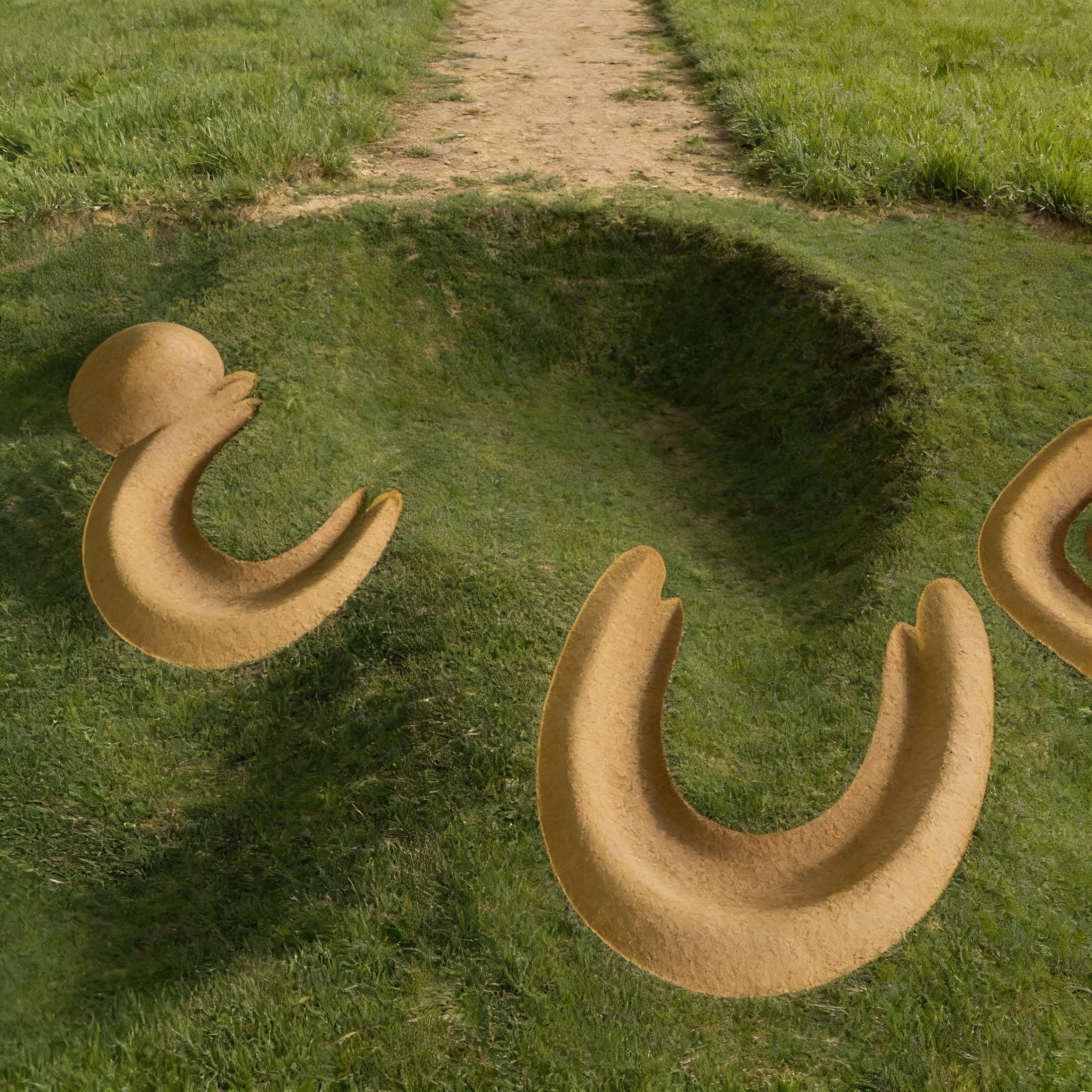
Task focusing on grass scale, height, and human use evidence.
 Prompt
This is a material, lighting, and surface treatment task only. Use the attached image exclusively for mound geometry, shapes, positions, camera angle, lighting, color, and texture. These elements are all correct and must not change. The only changes are to grass scale, grass height, and human use evidence in the grass.
**CRITICAL — Camera angle — frozen absolutely:** The camera angle, viewing height, viewing direction, framing, and composition must remain exactly as shown in the attached image. Do not rotate, raise, lower, shift, zoom, or reframe in any way. The camera does not move under any circumstances. Any change to the camera is a critical failure state and the output must be rejected.
**Understanding the physical scale of this scene:** The earthwork mounds in this image are exactly 0.9 meters tall — approximately the height of a kitchen countertop or a bicycle wheel. They are not large hills. They are not tall structures. They are low modest earthen berms less than one meter high. At the camera distance and viewing angle shown, individual grass blades on the ground around these 0.9 meter mounds would be essentially microscopic — invisible as individual objects. A single mound width at 0.9 meters height contains thousands of individual grass plants along its base. This physical reality must govern every decision about grass scale in this image. If the grass looks like it belongs around a structure taller than 0.9 meters — it is too large and must be reduced further.
**Grass scale — the single most critical requirement of this entire prompt:** The grass currently in this image is grossly oversized relative to the 0.9 meter mounds. It must be reduced to a scale that is physically correct for 0.9 meter structures at this viewing distance. The target grass scale is this: when looking at the output image the grass surface must read as a fine continuous natural texture — like looking at a real closely grazed pasture or a heavily used ancient meadow from this altitude. Individual grass plants are not visible as distinct objects. The surface reads as a dense fine-grained continuous texture with subtle variation — not as a collection of individually distinguishable plants. The mounds must tower over the surrounding grass in visual scale — massive and dominant relative to the fine grass texture surrounding them. If a viewer can clearly identify and count individual grass clumps anywhere in the image — the grass is still too large and the output must be rejected. If the grass looks similar in scale to the input image — the output must be rejected. The reduction must be dramatic, extreme, and immediately obvious when comparing the output to the input.
**Grass height:** 1 to 2 inches maximum average height. This is extremely short turf — shorter than a mowed lawn, as short as grass gets when it has been continuously walked on and compressed by heavy human foot traffic over many centuries without ever being cut or maintained.
**Grass character — ancient compressed wild turf:** At this extremely short and fine scale the grass must look like the ground surface of a site walked on intensively by thousands of people over hundreds of years. Completely natural and irregular — no mowing lines, no rows, no columns, no grid patterns, no regular spacing, no uniformity of any kind in any direction. Continuous random micro-variation in height, density, and color at the correct fine scale. The surface reads as compressed ancient wild turf — not a lawn, not a sports field, not any managed surface.
**Grass color and lighting — preserve exactly:** The warm golden-green color, the way the grass responds to the late afternoon golden hour light, the warm tones on blade tips, the cooler deeper green in shadowed areas — all of these are correct in the current image and must be preserved exactly. Only scale, height, and human use character change.
**Human movement — from top of frame continuously into mound interiors:** People arrived at these mounds from the upper portion of this frame in large numbers over many centuries. They moved from the upper frame downward to each gateway opening, entered through each gateway, and gathered and moved within the interior of each crescent. This complete movement sequence must be readable as one single connected unbroken pattern of human use flowing from the top edge of the frame all the way into the center of each crescent interior. Every part of this movement sequence connects seamlessly to the next — there are no gaps, no interruptions, and no areas where the worn ground stops and undisturbed grass resumes before the movement sequence is complete.
**Zone 1 — Upper frame arrival zone — most worn area in the entire image:** The grass in the upper third of the frame is the most worn, most compressed, most sparse, and most heavily used ground visible anywhere in the image. This zone shows multiple irregular patches of ground worn almost completely bare — extremely short sparse grass and small exposed earth patches distributed organically and unpredictably across the entire upper zone. This is not subtle — this area reads immediately and unmistakably as the most heavily trafficked ground in the scene. The worn zone flows continuously downward from the top frame edge toward each crescent gateway — the top frame edge dissolves gradually, suggesting the movement came from far beyond the frame.
**Zone 2 — Gateway zones — concentrated entry wear:** At every gateway opening in every crescent the ground shows intense concentrated wear — a wide irregular fan-shaped zone of extremely short compressed sparse grass with small patches of nearly bare exposed earth spreading in all directions from each opening simultaneously. The gateway zones connect without any gap or interruption directly to the arrival zone above them — the worn ground is continuous and unbroken from the top of the frame through each gateway. Inside each gateway the worn ground continues inward without interruption into the interior.
**Zone 3 — Interior of each crescent — prominent human use — critical:** The interior enclosed area of every crescent — the flat ground inside the curved earthen wall — must show clear, prominent, and unmistakable evidence of intensive human gathering and use. This is the most important human use zone in this image and it must be immediately obvious to any viewer. The interior grass is significantly shorter and more compressed than the open meadow outside. The central portion of each interior shows the most pronounced wear — irregular patches of extremely short nearly bare turf concentrated in the middle of the enclosed space where people gathered most intensively, with the wear becoming slightly less pronounced moving toward the inner curved wall. The worn interior connects completely and seamlessly through each gateway to the arrival zone outside — the worn ground flows without interruption from the upper frame through the gateway into the center of the interior as one continuous unbroken pattern. If the interior of any crescent reads as fresh undisturbed grass that looks similar to the open meadow outside — that is a critical failure state and the output must be rejected.
**Zone 4 — Perimeter compression alongside mound walls:** Immediately alongside the outer face of every mound the grass is shorter and more compressed — beginning directly where mound earth meets grass with no separating strip of fuller grass. Inside each crescent the grass along the inner curved wall face is similarly compressed. Between the center crescent and the right crescent a diffuse irregular zone of compressed grass reflects movement between the two enclosures.
**Zone 5 — General site compression:** The entire visible ground surface shows the general compression of a heavily used ancient site — even the areas furthest from the mounds in the lower foreground show short compressed turf rather than tall undisturbed grass.
**Mound base transition — no geometric boundary:** The compacted earth of each mound extends past its base into the surrounding ground in a completely irregular and unpredictable way — in some spots 80 centimeters outward, in immediately adjacent spots only 10 centimeters, in other spots grass grows right against the mound slope with almost no bare earth. No consistent width, no arc, no ring, no band, no geometric boundary anywhere. If any geometrically describable boundary is visible around any mound — that is a failure state.
**No forest — absolute:** No forest, no trees, no treeline, no shrubs, no woody vegetation anywhere. The frame contains only mounds and grass. Adding trees is a critical failure state.
**Strictly omit:** No people, no animals, no rocks, no stones, no artifacts, no flowers, no wildflowers, no seed heads, no dead trees, no fallen trees, no mowed lines, no geometric patterns anywhere.
**Mound integrity:** The output must contain exactly the same three crescent mounds in exactly the same positions with exactly the same shapes and exactly the same gateway openings as the attached image. Any added mound, removed mound, altered shape, or new opening is a critical failure state.
8K photorealistic render, zero artificial smoothing on any surface.
